Bookkeeping Cleanup: A Complete Guide to Fixing Messy Business Books
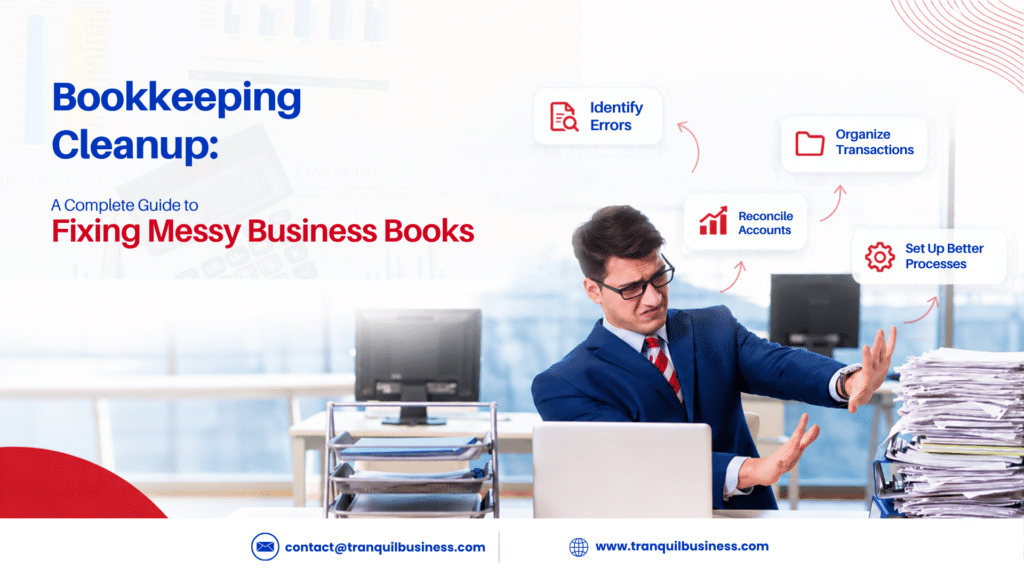
Introduction
It does not necessarily mean your books need to lag for several years before being difficult to manage.
The existence of a couple of bank transactions without reconciliation, duplicate entries, wrongly classified expenses, unpaid invoices, or outstanding balances could eventually create an even more serious accounting issue. By the time this is noticed, it might already be difficult for business owners to see what their real cash position, profit, or expenses are.
This is where bookkeeping cleanup comes in.
Bookkeeping cleanup refers to the activity of checking accounting records and cleaning them up before creating any financial reports.
This is not like adding new transactions in the books.
Bookkeeping cleanup involves a backward process that seeks to discover what was wrong with the previous entries in order to rectify it and establish a better ground to build on.
In this tutorial, we shall discuss the basics of bookkeeping cleanup, the most common challenges that companies encounter, a checklist of the cleanup process, and when to consider using bookkeeping services.
What Is Bookkeeping Cleanup?
Bookkeeping reconciliation is an organized activity aimed at fixing, organizing, and reconciling accounting records that have been found to be faulty and hard to understand.
A cleanup may involve reviewing:
- Bank accounts
- Credit card accounts
- Accounts receivable
- Accounts payable
- Income transactions
- Business expenses
- Payroll-related entries
- Loans and liabilities
- Fixed assets
- Owner or shareholder transactions
- Uncategorized transactions
- Suspense accounts
- Duplicate transactions
- Opening balances
- Financial statements
The exact work depends on how far the books have fallen behind and what problems exist in the accounting records.
For example, a business may have six months of unreconciled bank transactions. Another business may have accurate bank records but hundreds of incorrectly categorized expenses.
While both instances need cleaning up, the methods will be distinct.
Why Do Business Books Become Messy?
Generally, messy books never arise suddenly.
Rather, they tend to result from the delay in doing the accounting work as the company is busy with its sales and other activities.
Common causes include:
- Missed Bank Reconciliations
If bank accounts are not reconciled regularly, differences between the accounting system and actual bank activity can remain unnoticed. - Uncategorized Transactions
Bank feeds can create large numbers of transactions that remain uncategorized. Over time, these transactions make financial reports less useful. - Duplicate Transactions
Manual entries combined with imported bank transactions can sometimes result in duplicate records. - Incorrect Expense Categories
An expense may be recorded, but under the wrong account. This can distort the business’s profit and loss reporting. - Missing Invoices or Bills
When invoices, bills, or receipts are missing from the accounting system, accounts receivable and accounts payable may not represent the actual position of the business. - Personal and Business Transactions Mixed Together
When personal transactions are recorded through business accounts without proper classification, reviewing the books becomes more complicated. - Accounting Software Changes
Companies often change from one accounting system to another.
This transition process can be difficult for companies and lead to the need for an audit if not managed effectively.
10 Signs You May Need to Tidy Up Your Bookkeeping
Not sure whether your books need attention?
Look for these warning signs.
- Bank Accounts Are Not Reconciled
If your accounting software balance does not match your bank statements, the books should be investigated.
- Large Number of Uncategorized Transactions
A growing uncategorized or suspense balance can indicate that transactions have not been properly reviewed.
- Your Profit Doesn’t Look Right
If the reported profit seems completely different from what you expected based on sales and expenses, incorrect classifications or missing transactions may be involved.
- Accounts Receivable Doesn’t Match Reality
Your accounting system may show customers owing money even though some invoices have already been paid.
- Accounts Payable Contains Old Balances
Old vendor balances can indicate missing payments, duplicate bills, incorrect entries, or accounts that need review.
- No Reconciliation Is Done on Credit Card Accounts
It becomes hard to keep track of transactions involving credit cards when these do not get entered consistently.
- Your Accountant Keeps Finding the Same Errors
Repeated corrections during tax preparation or financial review may indicate an underlying bookkeeping process problem.
- Financial Reports Take Too Long to Prepare
If generating a reliable P&L or Balance Sheet requires significant manual work every month, the underlying bookkeeping system may need attention.
- You Are Preparing for a Tax Filing
Tax preparation becomes more efficient when the underlying books have already been reviewed and reconciled.
- You Cannot Easily Explain Your Numbers
This is perhaps the biggest warning sign.
If someone asks, “Why is this expense so high?” or “Why does this balance appear on the Balance Sheet?” and nobody can confidently explain it, your books may need a closer review.
Bookkeeping Organizational Guide
A systematic process makes cleanup easier.
Following is a checklist that businesses can implement.
Step 1: Gathering of Financial Information
Gather the relevant:
- Bank statements
- Credit card statements
- Loan statements
- Sales records
- Purchase invoices
- Vendor bills
- Payroll records
- Payment processor reports
- Tax records
- Previous financial statements
The exact documents required depend on the business and cleanup period.
Step 2: Consider the Accounting Period
Calculate precisely how far into the past the cleanup must go.
For instance:
January 2026 → September 2026
This ensures that the cleanup does not become an indefinite task.
Step 3: Reconcile Bank Accounts
Compare accounting records with actual bank statements.
Investigate:
- Missing transactions
- Duplicate transactions
- Incorrect amounts
- Outstanding items
- Unexplained differences
Bank reconciliation is one of the most important parts of a bookkeeping cleanup.
Step 4: Review Credit Card Accounts
Perform the same process for business credit cards.
Check:
- Purchases
- Payments
- Refunds
- Interest
- Fees
- Duplicate entries
- Missing transactions
Step 5: Clean Up Uncategorized Transactions
Review transactions that have not been assigned to appropriate accounts.
Instead of simply assigning everything to a generic expense category, each transaction should be reviewed based on the available supporting information.
Step 6: Review Accounts Receivable
Check open customer accounts.
Look for:
- Paid invoices still showing as unpaid
- Duplicate invoices
- Missing payments
- Old receivables
- Incorrect customer balances
Step 7: Review Accounts Payable
Check vendor balances and unpaid bills.
Make sure that:
- Payments are properly recorded
- Duplicate bills are removed
- Old balances are investigated
- Vendor statements are reviewed where necessary
Step 8: Review the Chart of Accounts
Your Chart of Accounts determines how transactions are organized within your accounting system.
A business can have problems when there are:
- Too many duplicate accounts
- Unclear account names
- Excessive miscellaneous categories
- Incorrect account classifications
- Accounts that are no longer required
Clean Chart of Accounts enhances understanding of financial reports.
Step 9: Evaluate Financial Statements
After corrections are made, review:
- Profit & Loss Statement
- Balance Sheet
- Cash Flow Statement
- Accounts Receivable Aging
- Accounts Payable Aging
The goal is not simply to make transactions look correct.
The resulting financial statements should also make sense.
Step 10: Implement a Continuous Accounting Procedure
Cleaning up must never be a once-a-year ritual.
Once the books are clean, establish a regular process for:
Transaction Recording → Reconciliation → Review → Reporting
This ensures that similar issues do not recur in the future.
Bookkeeping Cleanup Versus Catch-up Bookkeeping
The two terms are generally synonymous, but there may be a practical distinction.
Bookkeeping Cleanup
Focuses primarily on correcting existing records.
For instance:
- Incorrect classifications
- Duplicate transactions
- Reconciliation problems
- Incorrect balances
- Uncategorized transactions
- Catch-Up Bookkeeping
Focuses primarily on bringing overdue bookkeeping up to date.
For instance:
A business has not completed bookkeeping for April, May, June, and July.
The work required to record and process those missing months can be considered catch-up bookkeeping.
Sometimes You Need Both
A business that is six months behind may need to:
- Catch up the missing transactions
- Reconcile the accounts
- Correct historical errors
- Review financial statements
- Establish an ongoing bookkeeping process
That is why the first step should always be understanding the actual condition of the accounting records.
Why Bookkeeping Reconciliation Enhances Accounting Transparency
- Clean books are more than an administrative requirement.
They help business owners and finance teams understand what is actually happening inside the business. - Better Profitability Visibility
Accurate income and expense classifications provide a clearer view of profitability. - Better Cash Flow Awareness
Reconciled accounts make it easier to understand actual cash positions. - Better Receivables Management
Accurate customer balances help businesses identify outstanding invoices. - Easier Tax Preparation
Well-organized records can reduce the amount of historical cleanup required before tax work. - Better Financial Reporting
Management reports are more useful when the underlying accounting records are accurate and current. - Bookkeeping Cleanup: Should You Do It Yourself or Hire a Professional? Bookkeeping cleanup could be done by yourself for a very small business with simple transactions.
However, professional support can become useful when:
- Multiple months are behind
- Several bank accounts are involved
- Transactions are high volume
- Reconciliations contain unexplained differences
- Payroll or loan accounts are complicated
- The business recently changed accounting software
- Financial statements contain unusual balances
- Tax preparation is approaching
- Management needs reliable reports quickly
The important question is not simply “Can we enter the transactions?”
It is:
Can we confidently explain and support the financial information after the cleanup?
How Accounting Farm Can Help
When bookkeeping problems continue to accumulate, businesses often need more than transaction entry.
A structured accounting support process can include:
- Bookkeeping
- Bank and credit card reconciliation
- Accounts payable support
- Accounts receivable support
- Financial reporting
- Accounting software migration
- Payroll processing
- Ongoing accounting support
Accounting Farm can help businesses organize their accounting workflow and maintain cleaner financial records through ongoing bookkeeping and accounting support.
Need help reviewing your books?
👉 Contact Accounting Farm to discuss your bookkeeping requirements.
Final Thoughts
Bookkeeping clean-up is not simply about correcting old transactions.
It is about creating a reliable financial foundation for the business.
When bank accounts are reconciled, transactions are properly classified, receivables and payables are reviewed, and financial statements are checked, business owners can spend less time questioning their numbers and more time using them.
The best time to clean up messy books is before small accounting issues become larger financial problems.
And once the cleanup is complete, the next step is simple: maintain the books consistently so they stay clean.
FAQ
1.What is bookkeeping cleanup?
Bookkeeping cleanup is the activity of checking, correcting, reconciling, and organizing accounting documents which have errors or discrepancies in the data presented.
2. How often should bookkeeping cleanup be done?
In an ideal situation, companies would keep their books up to date consistently by means of bookkeeping and reconciliations. A cleanup can become necessary when these books are inaccurate or out of date.
3. What does a bookkeeping clean-up entail?
It may encompass bank reconciliation, credit card reconciliation, transaction classification, duplication elimination, review of accounts receivable and payable, and review of the Chart of Accounts.
4. Does bookkeeping clean-up equate to catch-up bookkeeping?
Not exactly. Catch-up bookkeeping generally focuses on bringing missing bookkeeping periods up to date, while cleanup focuses on correcting and organizing existing records. A business may need both.
5. Does tidying up bookkeeping make tax preparation easier?
Yes. Organized and reconciled accounting records can make the information needed for tax preparation easier to review. Tax requirements vary by jurisdiction, so businesses should coordinate with their tax professional for specific filing requirements.
6. Under what circumstances would the use of professional bookkeeping cleanup services be beneficial for an enterprise?
Professional help could be helpful in the following cases: the books are behind by several months, there are problems with reconciliation, there are numerous transactions per day, the accounting looks unreliable, etc.