Bookkeeping Cleanup: A Complete Guide to Fixing Messy Business Books
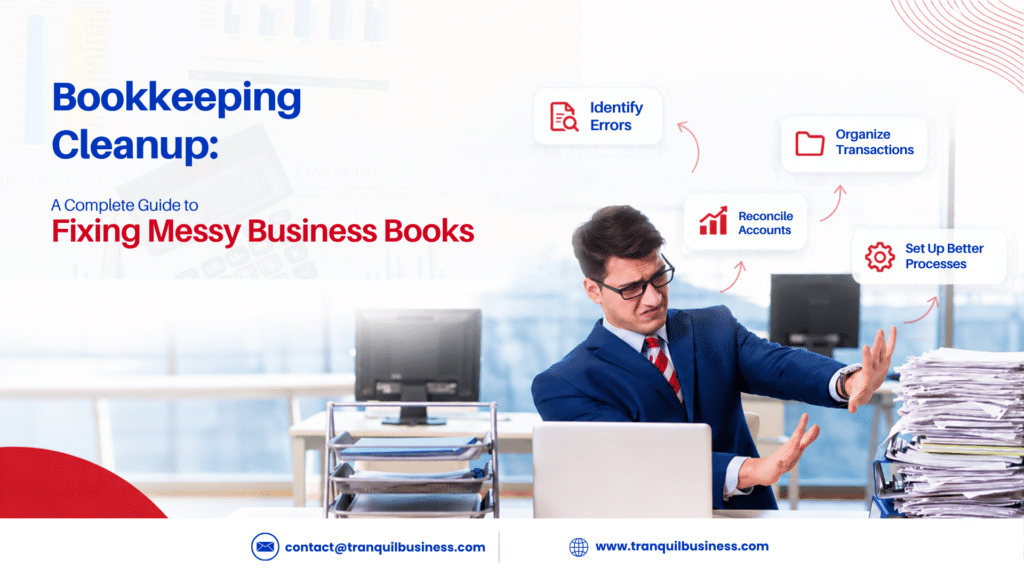
Bookkeeping Cleanup: A Complete Guide to Fixing Messy Business Books Introduction It does not necessarily mean your books need to lag for several years before being difficult to manage. The existence of a couple of bank transactions without reconciliation, duplicate entries, wrongly classified expenses, unpaid invoices, or outstanding balances could eventually create an even more serious accounting issue. By the time this is noticed, it might already be difficult for business owners to see what their real cash position, profit, or expenses are. This is where bookkeeping cleanup comes in. Bookkeeping cleanup refers to the activity of checking accounting records and cleaning them up before creating any financial reports. This is not like adding new transactions in the books. Bookkeeping cleanup involves a backward process that seeks to discover what was wrong with the previous entries in order to rectify it and establish a better ground to build on. In this tutorial, we shall discuss the basics of bookkeeping cleanup, the most common challenges that companies encounter, a checklist of the cleanup process, and when to consider using bookkeeping services. What Is Bookkeeping Cleanup? Bookkeeping reconciliation is an organized activity aimed at fixing, organizing, and reconciling accounting records that have been found to be faulty and hard to understand. A cleanup may involve reviewing: Bank accounts Credit card accounts Accounts receivable Accounts payable Income transactions Business expenses Payroll-related entries Loans and liabilities Fixed assets Owner or shareholder transactions Uncategorized transactions Suspense accounts Duplicate transactions Opening balances Financial statements The exact work depends on how far the books have fallen behind and what problems exist in the accounting records. For example, a business may have six months of unreconciled bank transactions. Another business may have accurate bank records but hundreds of incorrectly categorized expenses. While both instances need cleaning up, the methods will be distinct. Why Do Business Books Become Messy? Generally, messy books never arise suddenly. Rather, they tend to result from the delay in doing the accounting work as the company is busy with its sales and other activities. Common causes include: Missed Bank Reconciliations If bank accounts are not reconciled regularly, differences between the accounting system and actual bank activity can remain unnoticed. Uncategorized Transactions Bank feeds can create large numbers of transactions that remain uncategorized. Over time, these transactions make financial reports less useful. Duplicate Transactions Manual entries combined with imported bank transactions can sometimes result in duplicate records. Incorrect Expense Categories An expense may be recorded, but under the wrong account. This can distort the business’s profit and loss reporting. Missing Invoices or Bills When invoices, bills, or receipts are missing from the accounting system, accounts receivable and accounts payable may not represent the actual position of the business. Personal and Business Transactions Mixed Together When personal transactions are recorded through business accounts without proper classification, reviewing the books becomes more complicated. Accounting Software ChangesCompanies often change from one accounting system to another. This transition process can be difficult for companies and lead to the need for an audit if not managed effectively. 10 Signs You May Need to Tidy Up Your Bookkeeping Not sure whether your books need attention? Look for these warning signs. Bank Accounts Are Not Reconciled If your accounting software balance does not match your bank statements, the books should be investigated. Large Number of Uncategorized Transactions A growing uncategorized or suspense balance can indicate that transactions have not been properly reviewed. Your Profit Doesn’t Look Right If the reported profit seems completely different from what you expected based on sales and expenses, incorrect classifications or missing transactions may be involved. Accounts Receivable Doesn’t Match Reality Your accounting system may show customers owing money even though some invoices have already been paid. Accounts Payable Contains Old Balances Old vendor balances can indicate missing payments, duplicate bills, incorrect entries, or accounts that need review. No Reconciliation Is Done on Credit Card Accounts It becomes hard to keep track of transactions involving credit cards when these do not get entered consistently. Your Accountant Keeps Finding the Same Errors Repeated corrections during tax preparation or financial review may indicate an underlying bookkeeping process problem. Financial Reports Take Too Long to Prepare If generating a reliable P&L or Balance Sheet requires significant manual work every month, the underlying bookkeeping system may need attention. You Are Preparing for a Tax Filing Tax preparation becomes more efficient when the underlying books have already been reviewed and reconciled. You Cannot Easily Explain Your Numbers This is perhaps the biggest warning sign. If someone asks, “Why is this expense so high?” or “Why does this balance appear on the Balance Sheet?” and nobody can confidently explain it, your books may need a closer review. Bookkeeping Organizational Guide A systematic process makes cleanup easier. Following is a checklist that businesses can implement. Step 1: Gathering of Financial Information Gather the relevant: Bank statements Credit card statements Loan statements Sales records Purchase invoices Vendor bills Payroll records Payment processor reports Tax records Previous financial statements The exact documents required depend on the business and cleanup period. Step 2: Consider the Accounting Period Calculate precisely how far into the past the cleanup must go. For instance: January 2026 → September 2026 This ensures that the cleanup does not become an indefinite task. Step 3: Reconcile Bank Accounts Compare accounting records with actual bank statements. Investigate: Missing transactions Duplicate transactions Incorrect amounts Outstanding items Unexplained differences Bank reconciliation is one of the most important parts of a bookkeeping cleanup. Step 4: Review Credit Card Accounts Perform the same process for business credit cards. Check: Purchases Payments Refunds Interest Fees Duplicate entries Missing transactions Step 5: Clean Up Uncategorized Transactions Review transactions that have not been assigned to appropriate accounts. Instead of simply assigning everything to a generic expense category, each transaction should be reviewed based on the available supporting information. Step 6: Review Accounts Receivable
What Are the Costs of Outsourcing Bookkeeping? [Complete Guide for Small US Businesses in 2026]
What Are the Costs of Outsourcing Bookkeeping? [Complete Guide for Small US Businesses in 2026] See what actually drives the cost and get a quote built around your business. Target keyword: outsourced bookkeeping cost (USA) Quick answer: There’s no single average price for outsourced bookkeeping. That means anything for a business with 40 transactions a month, and one with 400 aren’t buying the same service, even if both call themselves small. What actually determines your number is transaction volume, number of accounts, whether payroll is involved, and how fast you need your books to be closed. The only accurate way to know your real cost is to price it against your actual books, not an industry average. If you’ve been quoted wildly different numbers by different providers, you’re not imagining it bookkeeping pricing genuinely varies this much because the underlying scope varies this much. Here’s exactly what drives the number up or down, so you know what you’re paying for before you get on a call. What Actually Determines Your Bookkeeping Cost Every outsourced bookkeeping quote is really answering five questions about your business: Transaction volume. This is the single biggest driver of price. The more transactions flow through your bank and card accounts each month, the more time reconciliation and categorization take, and the higher the fee. Number of bank and credit card accounts. Every additional account adds reconciliation to work. A business running separate accounts for payroll, operations, and a business card should expect a higher quote than one running everything through a single account. Payroll and contractor payments. Payroll is a separate system that has to reconcile into your books, not the same task as categorizing expenses. Whether payroll coordination is bundled in or billed separately changes your total meaningfully. Cash vs. accrual accounting. Accrual accounting means tracking receivables, payables, and accruals work that cash-basis books skip entirely. If your CPA or investors require accrual-basis financials, expect a more involved (and higher-priced) engagement. How fast do you need your close. A close delivered within 10–15 days gives you numbers you can act on right away. A close delivered at day 30 is last month’s news by the time you see it. Faster, senior-reviewed closes cost more and are usually worth it once you’re making real decisions off the numbers. The Difference between Outsourcing and In-House Production A full-time in-house bookkeeper will be burdened with fixed salary, payroll taxes, benefits, software cost, and the danger that your bookkeeping will grind to a halt when he/she falls sick or leaves. Outsourcing replaces that single point of failure with a team, at a cost built around the actual work your business generates not a flat headcount. The real question isn’t which is cheaper in the abstract. It’s whether a fixed employee cost with single-point-of-failure risk makes more sense for you than a flexible fee tied to your actual bookkeeping volume most growing businesses find outsourcing comes out meaningfully ahead on both cost and reliability. Red Flags in a Bookkeeping Quote Hourly billing. Fixed-fee providers are incentivized to be efficient. Hourly providers are incentivized for the opposite. A quote given before anyone looks at your books. A real quote requires a look at your transaction volume and current statements anything else is a guess dressed up as a number. No mention of who reviews the work. Bookkeeping with no senior or controller-level review is often just automated categorization with nobody checking it. Setup or catch-up fees buried until the contract stage. Clarify up front whether there will be any additional costs such as onboarding, catching up, or even software costs. Implications of this for Your Business f your books are behind, your monthly close takes longer than two weeks, or you’re heading into a financing round and need clean financials fast the fastest way to get a real number is to have it built around your actual transaction volume, not pulled from an industry average. [Get Your Free, Personalized Bookkeeping Quote →] (Link this CTA to your “Book a Call” / contact form) Frequently Asked Questions What is the price for outsourced bookkeeping for a small business firm? It will be dictated solely by the number of transactions you have, the number of accounts that need to be done, as well as payroll and senior review – that is why the price estimate is calculated specifically for your account. Is outsourcing bookkeeping less expensive than employing an in-house bookkeeper? For many smaller companies, certainly. A full-time in-house bookkeeper carries a fixed salary plus payroll taxes, benefits, and software costs and stops working the moment they’re out sick or leave. Outsourcing typically comes ahead on both total cost and reliability. What’s included in a standard outsourced bookkeeping package? A standard package typically includes bank and credit card reconciliation, transaction categorization, accounts payable/receivable tracking, payroll coordination, and monthly financial statements, though exact scope varies by provider. Why do bookkeeping quotes vary so much between providers? Because the scope varies just as much transaction volume, number of accounts, accounting basis (cash vs. accrual), and how much senior-level review is included all change what you’re paying for, even when two providers both call it bookkeeping. How do I find out what outsourced bookkeeping would actually cost for my business? The only accurate way is to have a provider look at your real transaction volume and account structure and quote against that not average. Most providers can turn this around in a few minutes once they see your books.
Bookkeeping vs Accounting: What’s the Difference (And Which Your Business Actually Needs)

Bookkeeping vs Accounting: What’s the Difference (And Which Your Business Actually Needs) Need a bookkeeper or an accountant? It is a frequently asked question by small business owners and no wonder, since both professionals deal with your finances, both make sure you are compliant, and their titles tend to get confused in everyday language. Bookkeeping and accounting are, however, two different things, and being aware of the difference can save you trouble. So here is the distinction between them, as well as how they relate to one another. Bookkeeping Definition Bookkeeping is the daily task of recording all the financial activities of your business. It involves everything from purchases to sales to payments. It’s the foundation layer of your entire financial system. A bookkeeper typically handles: Recording daily transactions Accounts Payable and Accounts Receivable Management Bank and Credit Card Statements Reconciliation Payroll Processing Maintaining Receipts and Supporting Documents Generating basic financial reports Think of bookkeeping as keeping the data accurate and organized it answers the question, “What happened financially, and when? What Is Accounting? Accounting is the use of the information provided by the bookkeeper to derive meaning from it. Accounting involves a more sophisticated process that is concerned with interpretation, analysis, and reporting of your business’ financial position. An Accountant normally performs tasks including: Preparation and analysis of financial statements Taxation Financial planning and budgeting Analysis of numbers Advising on business structure, compliance, and strategy Supporting audits and investor or lender reporting Accounting asks a different question: “What do these figures mean, and what needs to be done about it?” Bookkeeping versus Accounting: A Side-by-Side Comparison Bookkeeping Accounting Focus Recording transactions Interpreting financial data Timeframe Day-to-day Monthly, quarterly, annual strategy Skill level Data entry, organization Financial analysis, tax law, strategy Output Ledgers, reconciled accounts financial statements, forecasts, tax filings Key question answered What happened? But what does this mean, and what’s next? Why This Difference is Important to Your Business Jumping right into accounting without first having proper bookkeeping is like trying to create a financial forecast out of thin air the figures will not be accurate. Conversely, if you have perfect bookkeeping but no accounting at all, then you’re missing out on the strategic advice that will help you succeed, reduce your tax liability, and stay compliant. Bookkeeping and accounting are not rival fields they are steps in a process. Good books allow for good accounting, and good accounting allows your books to be useful. Bookkeeper or Accountant: What Do You Need? You likely need a bookkeeper if: You’re spending hours each week manually tracking transactions Your bank accounts haven’t been reconciled recently You’re not sure your financial records are accurate or up to date You likely need an accountant if: Tax season feels stressful or reactive rather than planned You need financial statements for a loan, investor, or grant application. You’re making major business decisions without a clear financial picture. You want help with long-term financial or tax strategy. Most growing businesses eventually need both. As your transaction volume increases, so does the value of having someone dedicated to keeping the books accurate, while a strategic advisor interprets that data and plans ahead. The Case for an Integrated Approach One of the biggest benefits of outsourcing your accounting is the way bookkeeping and accounting do not work separately but are intertwined as one whole process. Your books will be updated instantly, and their accuracy will contribute to better forecasting and tax planning. It is here that financial management at the level of Chief Financial Officer (CFO) proves to be useful for companies that scale up because they integrate everyday bookkeeping information with company strategy. Frequently Asked Questions Can one individual handle bookkeeping and accounting work? Yes, in case of very small scale companies. However, with increase in number and complexity of transactions, it is usually better for companies to split these two tasks. Is a bookkeeper less expensive than an accountant? Usually, yes. Bookkeeping is more of a standardized job whereas accounting requires a specialist who knows all about tax strategies and legislation, which normally costs more money. Do I still need an accountant if I am using accounting software? Accounting software will take care of some basic things such as automatic data entry and report generation, but not of your tax strategy or compliance. Get Both, Without the Overhead You shouldn’t have to choose between accurate books and strategic financial guidance and you shouldn’t have to hire a full in-house team to get both. At Tranquil Business, our team manages everything from routine accounting to finance strategy for maximum impact. This ensures that your figures are always correct and always serving you best. Schedule a free consultation to determine your company’s current requirements.
7 Signs Your Small Business Has Outgrown DIY Bookkeeping

7 Signs Your Small Business Has Outgrown DIY Bookkeeping Running a small business usually means doing a little bit of everything.You handle customers.You answer emails.You manage employees.You deal with suppliers.You worry about sales.And, somewhere between all of that, you try to keep your books updated.At the beginning, doing your own bookkeeping can make perfect sense.You might only have a few invoices, a couple of expenses, and one business bank account. Why pay someone else when you can handle it yourself?But businesses don’t stay small forever.As your sales increase, your transactions increase. You hire people. You add bank accounts. You start using different payment platforms. You have more invoices and expenses to track.And suddenly, bookkeeping that used to take an hour starts taking an entire afternoon.That’s usually when business owners start asking:“Should I still be doing my own bookkeeping?”If you’re asking yourself that question, here are seven signs your business may have outgrown DIY bookkeeping.1. Your Books Are Always BehindThis is probably the biggest warning sign.You tell yourself:“I’ll update everything this weekend.”Then the weekend comes.You’re busy with customers, family, sales, or other business tasks.So you move it to next weekend.A few weeks later, you’re looking at a pile of transactions and thinking, “How did I get this far behind?”When your books aren’t updated regularly, you lose visibility into what’s actually happening in your business.You may not know: How much money you’re really making Which customers still owe you money How much you’re spending Which expenses are increasing Whether your cash flow is healthy What your current profit actually looks like Bookkeeping isn’t just about entering numbers.It’s about keeping your financial information current enough to help you make decisions.If you’re consistently months behind, it may be time to get professional bookkeeping support.2. Your Business Has More Transactions Than You Can Keep Up WithWhen your business was starting out, maybe you had 20 or 30 transactions a month.That’s manageable.But then business picks up.Suddenly you have: Customer payments Supplier bills Bank transactions Credit card purchases Software subscriptions Payroll Refunds Online payments Business expenses And the list keeps growing.The problem isn’t necessarily that bookkeeping is difficult.It’s that there’s simply more of it now.Trying to manually keep track of hundreds or thousands of transactions can take a surprising amount of time.This is one of the reasons growing businesses often consider outsourced bookkeeping services.Instead of spending your time sorting transactions, you can focus on running the business.3. You Don’t Know Your Numbers Without Checking Everything FirstImagine someone asks:“How profitable was the business last month?”And your first thought is:“I’m not sure. Let me check.”That’s not necessarily a problem if you only need to look occasionally.But if you have no reliable, up-to-date financial information, it becomes difficult to make good business decisions.You should have a reasonably clear picture of things like: Revenue Expenses Profit Accounts receivable Accounts payable Cash flow You don’t need to become an accountant to understand your business finances.But you do need accurate information.Good bookkeeping gives you that visibility.4. You’re Spending More Time on Bookkeeping Than You ShouldHere’s an easy question to ask yourself:How many hours do you spend on bookkeeping every month?Maybe it’s five hours.Maybe it’s ten.Maybe it’s 20.Now think about what your time is worth as a business owner.Could those hours be spent: Finding new customers? Following up with leads? Improving your website? Training your team? Creating new services? Working with existing customers? Planning business growth? There’s nothing wrong with doing your own bookkeeping.But your time is also a business resource.If bookkeeping is taking you away from activities that actually grow the company, outsourcing may be worth considering.5. Tax Season Has Become a Stressful EventTax season shouldn’t be the first time you look closely at your financial records.But for many small businesses, that’s exactly what happens.They spend months putting off bookkeeping and then suddenly realize:“We need to get everything ready.”Now they’re searching for: Missing receipts Unpaid invoices Bank statements Business expenses Old transactions Incorrect entries And what could have been a simple monthly process turns into a major cleanup project.Keeping your books updated throughout the year makes tax preparation much easier.It also gives your accountant better information to work with.6. Your Business Has Started Using Multiple Accounting Systems or Payment PlatformsBusinesses become more complicated as they grow.Maybe you started with a simple business bank account.Now you’re using: QuickBooks Xero MYOB Stripe PayPal Shopify Multiple bank accounts Multiple credit cards Each system can create financial data that needs to be recorded and reconciled properly.For example, an eCommerce business may have sales coming through multiple platforms.A service business may have several payment methods.An international company may also deal with different currencies.At this point, bookkeeping isn’t simply about entering transactions.It’s about making sure the information from different sources is recorded correctly and the accounts actually match.7. Your Business Is Growing Faster Than Your Financial ProcessesThis is perhaps the most positive sign on the list.Your business is growing.More customers.More revenue.More employees.More expenses.More opportunities.That’s great.But growth also creates financial complexity.The bookkeeping process that worked when you had ten customers may not work when you have 100.The spreadsheet that worked at the beginning may eventually become difficult to manage.The few hours you spent on bookkeeping every month may turn into several days.That’s when it’s worth looking at a more structured bookkeeping system.DIY Bookkeeping Isn’t Always a Bad IdeaLet’s be clear.Doing your own bookkeeping isn’t automatically wrong.For a very small business with: Low transaction volume Simple finances One bank account Few customers Minimal expenses DIY bookkeeping may work perfectly well.The problem is continuing with the same system after the business has changed.Think of it this way.You wouldn’t use the same sales strategy forever just because it worked when you started.Your financial processes should evolve too.What Happens If You Ignore the Problem?Falling behind on bookkeeping might not seem like a big deal at first.But small issues can become bigger problems.For example:Missed invoicesYou may forget to follow up with customers who haven’t paid.Incorrect expensesExpenses can be categorized incorrectly or completely missed.Poor cash-flow visibilityYou might think you have more available cash than you actually do.Difficult tax preparationYour accountant may need to spend additional time cleaning up your records.Bad business decisionsYou could make decisions based on outdated or incomplete financial information.The longer bookkeeping problems continue, the harder they can become to fix.Should You Hire a Bookkeeper or Outsource Bookkeeping?This is where many business owners get stuck.Should you hire someone internally?Or should you outsource?There isn’t one answer that works for every business.An in-house bookkeeper can make sense when you have enough ongoing work to justify a full-time employee.But if you only need several hours of bookkeeping support each
10 Benefits of Outsourcing Accounting for Small Businesses

10 Benefits of Outsourcing Accounting for Small Businesses Introduction Running a small business comes with endless responsibilities. From managing employees and serving customers to driving sales and planning for growth, business owners often wear multiple hats. Amid all these priorities, accounting is one area that frequently gets pushed aside. Unfortunately, even small bookkeeping mistakes can lead to cash flow issues, tax penalties, or poor financial decisions. This is why more businesses are turning to outsourced accounting services. Instead of hiring and managing an in-house accounting team, companies partner with experienced accounting professionals who handle everything from bookkeeping and payroll to financial reporting and tax preparation. Outsourcing accounting is no longer just a cost-saving strategy it has become a smart business decision. It allows business owners to focus on growth while experts ensure that financial records remain accurate, compliant, and up to date. In this article, we’ll explore the top 10 benefits of outsourcing accounting for small businesses and explain why this approach is helping companies become more efficient, profitable, and future-ready. Why More Small Businesses Are Outsourcing Accounting Small businesses often have limited budgets and resources. Hiring experienced accountants, purchasing accounting software, and keeping up with changing tax regulations can become expensive and time-consuming. By outsourcing accounting, businesses gain access to qualified professionals, advanced technology, and reliable financial insights without the overhead costs of maintaining an internal accounting department. 1. Significant Cost Savings One of the biggest advantages of outsourcing accounting is reducing operational costs. Hiring an in-house accountant involves salaries, employee benefits, office space, training, software subscriptions, and recruitment expenses. Outsourcing eliminates many of these costs while giving businesses access to experienced professionals. Instead of paying a full-time salary, businesses only pay for the accounting services they actually need. Benefits Lower payroll expenses No recruitment costs No employee benefits Reduced software investment Predictable monthly pricing 2. Access to Experienced Accounting Professionals Accounting regulations continue to evolve every year. Professional accounting firms stay updated with the latest tax laws, compliance requirements, and financial reporting standards. This means businesses receive accurate advice from experienced professionals rather than relying on a single employee with limited expertise. Expert accountants can also identify opportunities to improve financial efficiency and reduce unnecessary expenses. 3. More Time to Focus on Business Growth Many business owners spend hours every week organizing receipts, reconciling bank accounts, processing invoices, and preparing reports. These repetitive tasks reduce the time available for activities that actually generate revenue. Outsourcing accounting frees up valuable time so business owners can focus on: Customer relationships Sales Marketing Product development Business expansion 4. Improved Financial Accuracy Accounting mistakes can be expensive. Errors in bookkeeping may lead to inaccurate financial reports, missed tax deadlines, duplicate payments, or cash flow problems. Professional accounting teams use standardized processes and quality checks to minimize errors and maintain reliable financial records. Accurate books also make budgeting and business planning much easier. 5. Better Cash Flow Management Cash flow is one of the biggest challenges for small businesses. Professional accountants help businesses: Monitor incoming payments Track expenses Identify unnecessary costs Forecast future cash flow Improve working capital This allows businesses to avoid cash shortages and make smarter financial decisions. 6. Easier Tax Compliance Tax regulations can be complex and change frequently. Outsourced accountants help ensure: Accurate tax calculations Timely filings Proper documentation Compliance with regulations Maximum eligible deductions This reduces the risk of penalties and gives business owners greater peace of mind. 7. Access to Advanced Accounting Technology Professional accounting firms invest in modern cloud-based accounting software and automation tools. Businesses benefit from features such as: Real-time financial reporting Secure cloud storage Automated bookkeeping Digital invoice management Easy document sharing Without paying for expensive software licenses themselves. 8. Better Financial Reporting Accurate reports help business owners understand: Profitability Revenue trends Expenses Cash flow Business performance These insights support better planning and faster decision-making. Instead of guessing, businesses make decisions based on reliable financial data. 9. Scalability as Your Business Grows As a business expands, its accounting needs become more complex. Outsourced accounting services can easily scale by supporting: More transactions Additional employees Multiple business locations Payroll expansion Financial forecasting Without the hassle of hiring additional staff. 10. Reduced Stress and Greater Peace of Mind Knowing that qualified professionals are handling your finances allows business owners to concentrate on running the business. Instead of worrying about bookkeeping errors or tax deadlines, they gain confidence that their financial operations are in capable hands. This peace of mind is one of the most valuable long-term benefits of outsourcing accounting. Common Mistakes Businesses Make Before Outsourcing Waiting until tax season Choosing providers based only on price Failing to define service expectations Not reviewing monthly financial reports Delaying bookkeeping for months Frequently Asked Questions Is outsourcing accounting suitable for startups? Yes. Startups often benefit from outsourced accounting because it provides professional financial support without the cost of hiring a full-time accounting team. Is outsourced accounting secure? Reputable accounting firms use secure cloud platforms, encrypted data storage, and strict confidentiality practices to protect financial information. Can outsourced accountants handle payroll? Yes. Many providers offer payroll processing, employee tax filings, compliance management, and payroll reporting as part of their services. Does outsourcing replace accounting software? No. Most accounting firms work with modern cloud accounting software, allowing businesses to access real-time financial information while professionals manage the records. Conclusion Outsourcing accounting has become a practical solution for small businesses that want to reduce costs, improve financial accuracy, and focus on growth. From expert bookkeeping and tax compliance to better cash flow management and detailed financial reporting, outsourced accounting services offer businesses the flexibility and expertise needed to thrive in today’s competitive market. If your business is spending too much time managing finances or struggling to keep up with accounting tasks, outsourcing may be the next step toward improved efficiency and long-term success.
5 Signs Your Small Business Needs to Outsource Bookkeeping (Before It’s Too Late)
5 Signs Your Small Business Needs to Outsource Bookkeeping (Before It’s Too Late) Ask any small business owner what they hate doing most, and bookkeeping usually comes up in the top three. Not because it’s hard, exactly most of it is repetitive, not complicated but because it eats into evenings and weekends that were supposed to be for something else. A lot of owners start out doing their own books with good intentions. Maybe it’s a spreadsheet, maybe it’s a free trial of some accounting app. It works fine for a while. Then the business picks up, invoices start piling in from three different clients in the same week, and suddenly nobody’s opened the books in a month. Sound familiar? That gap between “I’ll get to it” and actually getting to it is where most bookkeeping problems start. Below are five signs that gap has gotten too wide, plus what actually changes once you hand the work over to someone else. Why This Keeps Happening It’s not that owners don’t care about their numbers. It’s that nothing about bookkeeping feels urgent until it suddenly is. A client emailing about a late invoice feels urgent. A supplier call feels urgent. Reconciling last month’s bank statement does not until tax season, or a loan application, or an investor call makes it very urgent all at once. By then you’re not just doing bookkeeping, you’re doing months of it in a panic. That’s usually the point where people start looking into outsourcing, though honestly, it’s worth doing sooner. 1. You Have to “Check” Before You Can Answer a Basic Money Question If a friend asked how the business is doing right now and you’d need to open three tabs and squint at a spreadsheet before answering, that’s worth paying attention to. Not because it’s embarrassing, but because it means you’re running the business partly blind. Business owners who’ve handed bookkeeping off usually get a report every week or two that actually tells them something what came in, what went out, what’s left. It sounds small, but knowing your numbers without digging for them changes how confidently you make decisions, especially the bigger ones. 2. Tax Season Turns Into a Scramble If you’re one of those people who’s still finding receipts in your car in March, this one’s for you. Messy books at tax time usually mean two things: a stressful few weeks, and deductions you probably missed because nobody had time to track them properly all year. A bookkeeper who’s on top of things keeps your records clean as you go, so by the time your accountant needs anything, it’s already sitting there ready. No digging through old emails for a receipt from last September. It’s a small thing until you’ve lived through the alternative a few times. 3. You’ve Lost Track of What Software You’re Even Supposed to Be Using QuickBooks, Xero, Wave, Zoho there’s no shortage of options, and honestly, most of them do the job fine. The problem isn’t usually the software. It’s that half of it never got set up properly, or categories got created and forgotten, or there are three ways the same expense type shows up depending on who entered it. This kind of mess doesn’t fix itself. Someone who does bookkeeping for a living will set the system up correctly the first time and keep it that way, which saves you from a much bigger, much more annoying cleanup job later. 4. Growth Is Outpacing Your Ability to Keep Up Ten transactions a month is manageable in a notebook if you really wanted. Two hundred a month is a different animal. As a business grows more clients, more employees, maybe a new product line the bookkeeping load grows with it, and a lot of owners don’t notice until they’re buried. This is usually where outsourcing stops being a “maybe someday” thing and becomes obviously worth it. It’s also worth mentioning: if you’re ever talking to a lender or an investor, the first thing they’ll want to see is clean financials. Scrambling to produce those on short notice doesn’t leave a great impression. 5. You’re Doing Bookkeeping Instead of Doing the Thing That Actually Grows Your Business This one’s the real cost, and it’s easy to underestimate. Every hour spent reconciling transactions or fixing a mislabeled expense is an hour not spent talking to a client, chasing a new lead, or actually building the business. Add it up over a month and it’s often more hours than people expect sometimes a full workday or two, sometimes more. That time has a cost even if it doesn’t show up on an invoice. Getting it off your plate isn’t just about convenience, it’s about where your attention goes. “But Isn’t Outsourcing Expensive?” This comes up a lot, and it’s a fair question. But it’s worth flipping around: what does it actually cost to do it yourself, badly? Missed deductions. Late fees. Decisions made on wrong or outdated numbers. Hours of your own time that could’ve gone toward something that actually makes money. DIY bookkeeping feels free the way ignoring a small leak feels free right up until it isn’t. A decent outsourced bookkeeping service has a predictable monthly cost, and for most small businesses, it ends up paying for itself pretty quickly once you factor in what it’s actually saving you. DIY vs. Outsourced Time: DIY quietly eats hours you don’t have. Outsourcing gives them back. Accuracy: DIY books are prone to small errors that compound. Trained bookkeepers catch what most owners miss. Tax time: DIY often means scrambling in March. Outsourced keeps things ready year-round. Growth: DIY systems tend to crack once volume picks up. Outsourced setups are built to scale. Cost: DIY looks free on paper. Outsourcing is a known cost that usually prevents bigger ones. If You’re Going to Outsource, Here’s What Actually Matters Not every bookkeeping service is the same, and picking one isn’t just
How to Track Expenses Without Losing Your Mind
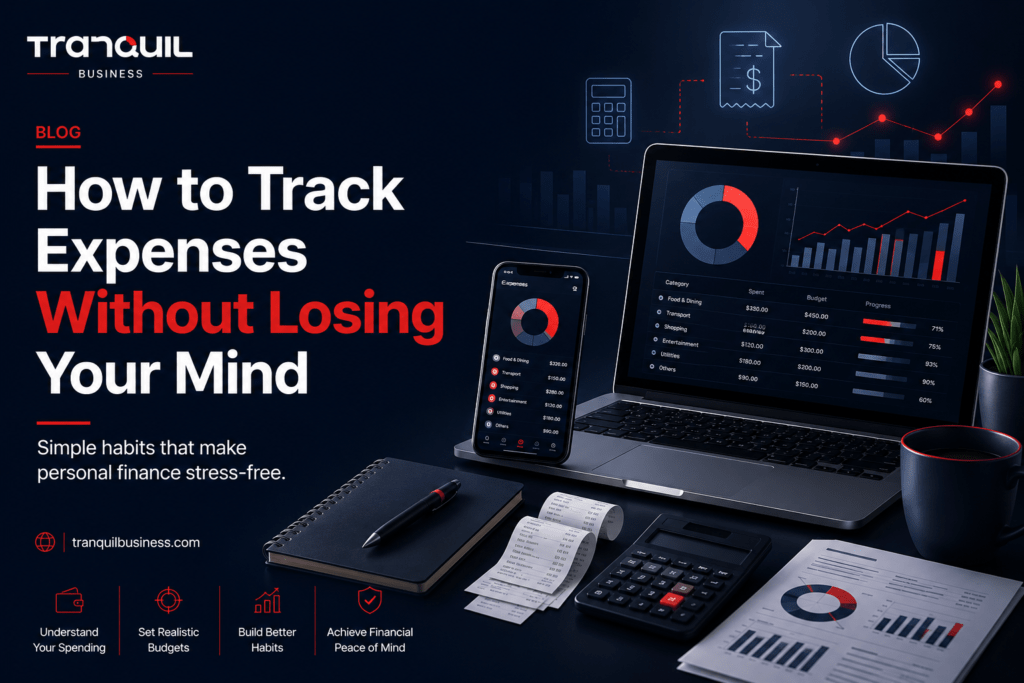
How to Track Expenses Without Losing Your Mind Managing money can sometimes feel confusing and stressful, especially when you don’t know where your income goes every month. Many people struggle with overspending simply because they never track their daily expenses. This is where personal finance tracking becomes important. It helps you understand your spending habits, improve budgeting, and save money more effectively. The best part is that expense tracking doesn’t need to be complicated. You don’t have to spend hours updating spreadsheets or using difficult financial tools. A simple and consistent routine is enough to stay financially organized without losing your mind. At Tranquil Business, we believe smart financial habits can make everyday life easier and less stressful. Why Personal Finance Tracking Is Important Many people avoid budgeting because they think it is stressful. However, personal finance tracking actually reduces stress by giving you better control over your money. Benefits of Tracking Expenses When you know your spending habits, it becomes easier to make smarter financial decisions. Start with Simple Expense Categories One of the biggest mistakes beginners make is tracking too many things at once. This often becomes overwhelming and difficult to maintain. Instead, keep your categories simple such as: Simple categories make personal finance tracking easier and more effective. Choose an Easy Tracking Method The best expense tracking method is the one you can follow consistently. At Tranquil Business, we always recommend choosing a system that fits your daily lifestyle. 1. Use a Notebook Writing expenses in a notebook is one of the easiest ways to start. You only need to record: This method works well for beginners because it builds awareness about spending habits. 2. Use a Spreadsheet Spreadsheets are useful for people who like organized financial records. You can calculate monthly totals and compare spending patterns easily. Benefits Include: 3. Use Budgeting Apps Budgeting apps automate most of the work and save time. Many apps automatically categorize expenses and show spending reports. Common Features: Apps make personal finance tracking much more convenient for busy people. Spend Just 5 Minutes Daily One of the simplest ways to stay consistent is by updating your expenses every day. Spending only 5 minutes daily can prevent financial confusion later. Daily Tracking Helps You: Small habits create long-term financial improvement. Review Your Spending Weekly Weekly reviews are important because they help you identify unnecessary expenses before they become bigger problems. During Your Weekly Review: This habit improves your overall personal finance tracking system. Avoid Common Expense Tracking Mistakes Many people quit tracking because they make the process too difficult. Avoid these common mistakes: 1. Tracking Too Many Categories Too much detail creates confusion. 2. Ignoring Small Purchases Small daily expenses add up quickly over time. 3. Trying to Be Perfect No budget is perfect. Focus on consistency instead. 4. Forgetting to Review Expenses Tracking alone is not enough. Reviews help improve spending habits. Tips to Make Personal Finance Tracking Easier At Tranquil Business, we recommend these simple tips to make expense tracking stress-free: The easier your system feels, the more likely you are to continue using it. Conclusion Tracking expenses doesn’t have to feel complicated or mentally exhausting. With a simple routine and consistent habits, personal finance tracking can help you take control of your money without stress. Start small, stay organized, and focus on building better financial habits over time.Even small improvements in managing money can lead to better savings, reduced stress, and stronger financial security in the future. Tranquil Business encourages everyone to build smarter financial habits for a more secure and stress-free life.
Affordable Accounting Service: Smart Accounting Solutions for Startups
Affordable Accounting Service: Smart Accounting Solutions for Startups Starting a business is exciting, but managing finances can quickly become overwhelming. From tracking expenses to filing taxes, startups often struggle to balance growth with proper financial management. That’s why choosing affordable accounting services is one of the smartest investments a startup can make. In today’s competitive market, businesses need reliable accounting solutions for startups that not only save time but also improve financial accuracy and long-term planning. Whether you’re a small business owner, entrepreneur, or founder launching your first venture, the right accounting support can help you scale with confidence. Why Startups Need Professional Accounting Services Many startups begin by handling bookkeeping manually or using spreadsheets. While this may work initially, financial complexity increases as the business grows. Professional accounting services help startups: Affordable accounting support gives startups access to expert financial guidance without hiring a full-time in-house accountant. What Are Accounting Solutions for Startups? Accounting solutions for startups are specialized financial services designed to meet the needs of early-stage businesses. These solutions typically include bookkeeping, payroll management, tax preparation, financial reporting, and business advisory services. Unlike traditional accounting firms, startup-focused accounting services are flexible, scalable, and budget-friendly. Common Services Included 1. Bookkeeping Services Accurate bookkeeping helps startups monitor income, expenses, invoices, and transactions in real time. 2. Tax Preparation and Filing Tax regulations can be confusing for new businesses. Professional accountants ensure timely filing and maximize available deductions. 3. Payroll Management Managing employee salaries, benefits, and tax deductions becomes easier with automated payroll services. 4. Financial Reporting Monthly profit and loss statements, balance sheets, and cash flow reports help founders understand business performance. 5. Business Advisory Experienced accountants provide strategic advice for budgeting, forecasting, fundraising, and scaling operations. Benefits of Affordable Accounting Services Saves Time and Increases Productivity Startup founders already juggle multiple responsibilities. Outsourcing accounting tasks allows teams to focus on product development, marketing, and customer growth. Reduces Financial Errors Even small accounting mistakes can lead to penalties or poor financial decisions. Professional services ensure accuracy and compliance. Cost-Effective for Startups Hiring a full-time accountant can be expensive. Affordable accounting services provide expert support at a fraction of the cost. Improves Cash Flow Management Cash flow is critical for startup survival. Accountants help monitor spending and optimize financial planning. Supports Business Growth As startups grow, financial needs become more complex. Scalable accounting solutions adapt to changing business requirements. How to Choose the Right Accounting Service for Your Startup Finding the right accounting partner is essential. Here are some factors to consider: Industry Experience Choose accountants who understand startup challenges and your specific industry. Technology Integration Look for cloud-based accounting software integration for real-time financial access. Transparent Pricing Affordable services should offer clear pricing without hidden charges. Scalability Ensure the accounting service can grow with your business. Customer Support Reliable communication and ongoing support are essential for financial success. Best Accounting Tools for Startups Modern startups often combine professional services with accounting software for better efficiency. Popular accounting tools include: These platforms simplify invoicing, expense tracking, and financial reporting. Why Affordable Accounting Services Matter in 2026 The startup ecosystem continues to grow rapidly, and financial management is more important than ever. Investors, lenders, and stakeholders expect startups to maintain accurate financial records and transparent reporting. Affordable accounting services help startups remain financially organized while minimizing operational costs. With the right accounting partner, startups can focus on innovation and business expansion instead of worrying about numbers. Final Thoughts Every startup needs strong financial management to succeed. Investing in affordable accounting services provides startups with the expertise, efficiency, and financial clarity needed for sustainable growth. Whether you’re launching a tech company, eCommerce store, or service-based business, choosing the right accounting solutions for startups can improve decision-making, streamline operations, and prepare your business for long-term success. If you want to grow your startup confidently, now is the perfect time to explore affordable and scalable accounting services tailored to your business needs.
7 Best Invoice Accounting Softwares for Businesses in 2026
7 Best Invoice Accounting Softwares for Businesses in 2026 Managing invoices manually can slow down business operations and increase the risk of payment delays or accounting errors. That’s why many businesses are now investing in reliable invoice management software to automate billing, track payments, and improve financial organization. At Tranquil Business, we understand how important efficient invoicing is for maintaining healthy cash flow and professional client relationships. Choosing the right software can help businesses save time, reduce mistakes, and improve overall financial management.In this article, we will explore the 7 best invoice accounting softwares that can help businesses streamline invoicing and accounting processes in 2026. What Is Invoice Management Software? Invoice management software is a digital solution that helps businesses create, send, track, and manage invoices automatically. It also assists with payment reminders, expense tracking, tax calculations, and financial reporting. A good invoice management software can help businesses: 1. QuickBooks Online QuickBooks Online is one of the most popular accounting platforms for small and medium-sized businesses. Key Features Best For Small businesses and freelancers looking for an all-in-one accounting and invoicing solution. Why It Stands Out QuickBooks Online combines accounting, payroll, invoicing, and reporting in one platform, making it a reliable invoice management software for growing businesses. 2. FreshBooks FreshBooks is known for its user-friendly interface and excellent invoicing capabilities. Key Features Best For Freelancers, consultants, and service-based businesses. Why It Stands Out FreshBooks makes invoicing simple and professional, especially for businesses that bill clients hourly or on recurring schedules. 3. Xero Xero is a cloud-based accounting platform designed for small businesses and accountants. Key Features Best For Businesses that need scalable accounting and invoicing tools. Why It Stands Out Xero offers strong automation features and seamless integrations, making it an effective invoice management software for expanding companies. 4. Zoho Invoice Zoho Invoice is an affordable invoicing solution with powerful automation tools. Key Features Best For Small businesses and startups looking for budget-friendly invoicing software. Why It Stands Out Zoho Invoice offers professional invoicing features without high costs, making it ideal for startups and small teams. 5. Wave Accounting Wave Accounting is a free accounting and invoicing solution popular among small business owners. Key Features Best For Freelancers and small businesses with limited budgets. Why It Stands Out Wave Accounting provides free invoicing and accounting tools, making it one of the best entry-level invoice management software options available. 6. Sage Accounting Sage Accounting is designed to simplify accounting and invoicing for businesses of all sizes. Key Features Best For Businesses needing advanced accounting and compliance support. Why It Stands Out Sage Accounting is particularly useful for businesses that require detailed financial management and compliance tracking. 7. NetSuite ERP NetSuite ERP is an enterprise-level accounting and invoicing platform. Key Features Best For Large businesses and enterprises. Why It Stands Out NetSuite ERP provides advanced automation and scalability for businesses managing high invoice volumes and complex financial operations. Comparison Table: Best Invoice Management Software Software Best For Key Strength Cloud-Based Free Plan Available QuickBooks Online Small businesses Complete accounting solution Yes No FreshBooks Freelancers Easy invoicing Yes No Xero Growing businesses Automation & integrations Yes No Zoho Invoice Startups Affordable invoicing Yes Yes Wave Accounting Small businesses Free accounting tools Yes Yes Sage Accounting Medium businesses Compliance & reporting Yes No NetSuite ERP Enterprises Advanced scalability Yes No How to Choose the Right Invoice Management Software When selecting the best invoice management software, consider the following factors: Business Size Choose software that matches your company’s current needs and future growth. Budget Some platforms offer free plans, while others require monthly subscriptions. Automation Features Look for automatic invoicing, reminders, and payment tracking. Integration Options Ensure the software integrates with payment gateways, CRM systems, and accounting tools. User Experience A simple and easy-to-use dashboard can improve productivity. Benefits of Using Invoice Management Software Implementing invoice software can help businesses: At Tranquil Business, we recommend businesses invest in reliable invoicing systems to streamline accounting operations and improve financial efficiency. Final Thoughts Choosing the right invoice management software can significantly improve business operations, financial accuracy, and client satisfaction. Whether you are a freelancer, startup, or enterprise business, there are invoicing solutions available to meet your specific needs. Platforms like QuickBooks Online, FreshBooks, and Xero continue to lead the market because of their automation features, ease of use, and strong accounting capabilities. By investing in the right invoice management solution, businesses can simplify financial processes, strengthen cash flow management, and support long-term growth.
Managing Client Expectation for Accountant
In the accounting industry, technical expertise is only part of the equation. Clients also expect clarity, responsiveness, and transparency throughout the financial process. That’s why professional communication skills have become one of the most valuable assets for accountants who want to build trust, retain clients, and grow their practice. At Tranquil Business, we understand that successful accounting is not only about numbers — it is also about building strong client relationships through effective communication and professional service. Whether you work as an independent accountant, manage a small accounting firm, or serve corporate clients, learning how to manage client expectations effectively can strengthen relationships and prevent misunderstandings before they happen. Why Managing Client Expectations Is Important in Accounting Accounting involves sensitive financial information, deadlines, compliance requirements, and strategic advice. Clients often rely on accountants during stressful situations such as tax season, audits, or financial planning. Without proper communication, clients may: Strong professional communication skills help accountants create realistic expectations while maintaining a positive client experience. What Are Professional Communication Skills in Accounting? Professional communication skills refer to the ability to share information clearly, respectfully, and effectively with clients, colleagues, and stakeholders. For accountants, these skills include: These communication abilities are just as important as technical accounting knowledge because they directly affect client satisfaction. 1. Set Clear Expectations From the Beginning One of the best ways to avoid future problems is to define expectations early. During onboarding, explain: Clients appreciate transparency. When accountants clearly communicate what they can and cannot do, misunderstandings become less likely. Example Instead of saying: “I’ll complete your tax filing soon.” Say: “Your tax return will be completed within 7 business days after receiving all required documents.”This level of clarity demonstrates strong professional communication skills and builds trust immediately. 2. Use Simple Language Instead of Accounting Jargon Many clients do not have a financial background. Using complicated accounting terms can create confusion and frustration. Professional accountants should simplify technical concepts whenever possible. Better Communication Example Instead of saying: “Your liquidity ratio indicates insufficient short-term solvency.” Say: “Your business may struggle to cover short-term expenses with the cash currently available.” At Tranquil Business, simplifying financial communication helps clients feel informed, confident, and involved in important business decisions. 3. Respond Promptly and Professionally Clients value responsiveness. Even if you do not have an immediate solution, acknowledging messages quickly shows professionalism. Best Practices Consistent communication demonstrates reliability and strengthens client relationships. 4. Be Honest About Deadlines and Limitations Overpromising is one of the fastest ways to damage trust. If a task requires additional time, explain the reason honestly. Most clients appreciate transparency more than unrealistic promises. Example A professional response could be: “Due to additional compliance checks, the report will require two more days to ensure complete accuracy.” This approach reflects excellent professional communication skills while protecting your professional reputation. 5. Practice Active Listening Good communication is not only about speaking clearly. It also involves understanding the client’s concerns. Active listening means: When clients feel heard, they are more likely to trust your recommendations. 6. Manage Difficult Conversations Professionally Accountants sometimes need to discuss sensitive topics such as tax penalties, cash flow issues, or financial losses. During difficult conversations: For example: “I understand this situation is stressful. Let’s review the available options to reduce future risks.” This balanced approach helps maintain positive client relationships during challenging situations. 7. Provide Regular Updates Clients dislike uncertainty. Regular updates help them feel informed and involved. You can send updates regarding: Proactive communication reduces client anxiety and demonstrates professionalism. 8. Build Long-Term Relationships Through Trust Trust is the foundation of every successful accountant-client relationship. Strong professional communication skills help accountants: At Tranquil Business, building long-term client trust through transparent and professional communication is considered a core part of quality accounting services. Clients are more likely to remain loyal when they feel respected, informed, and supported. Common Communication Mistakes Accountants Should Avoid Here are some common mistakes that can negatively impact client relationships: Poor Follow-Up Ignoring emails or delaying responses creates frustration. Using Excessive Technical Language Clients may feel overwhelmed or confused. Lack of Transparency Hidden fees or unclear timelines damage trust. Defensive Communication Remaining calm and solution-focused is essential during disagreements. Inconsistent Updates Clients should never feel uncertain about project progress. Avoiding these mistakes can significantly improve client satisfaction. How Technology Can Improve Client Communication Modern accounting tools can improve efficiency and communication. Useful tools include: Technology supports better communication while helping accountants stay organized and responsive. Final Thoughts Managing client expectations is one of the most important responsibilities for accountants today. While technical expertise remains essential, strong professional communication skills often determine whether clients stay loyal or seek another provider. Clear communication, transparency, responsiveness, and empathy all contribute to better client experiences and stronger professional relationships. Accountants who master communication not only reduce misunderstandings but also position themselves as trusted financial advisors in a highly competitive market. By improving your professional communication skills, accounting professionals and firms like Tranquil Business can create long-term client trust, enhance reputation, and grow a successful accounting practice.