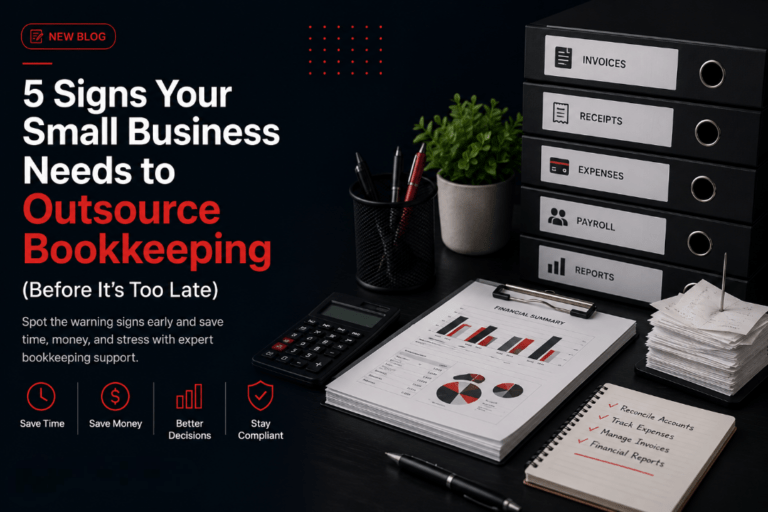
5 Signs Your Small Business Needs to Outsource Bookkeeping (Before It's Too Late)
Ask any small business owner what they hate doing most, and bookkeeping usually comes up in the top three. Not because it’s hard, exactly most of it is repetitive, not complicated but because it eats into evenings and weekends that were supposed to be for something else.
A lot of owners start out doing their own books with good intentions. Maybe it’s a spreadsheet, maybe it’s a free trial of some accounting app. It works fine for a while. Then the business picks up, invoices start piling in from three different clients in the same week, and suddenly nobody’s opened the books in a month. Sound familiar?
That gap between “I’ll get to it” and actually getting to it is where most bookkeeping problems start. Below are five signs that gap has gotten too wide, plus what actually changes once you hand the work over to someone else.
Why This Keeps Happening
It’s not that owners don’t care about their numbers. It’s that nothing about bookkeeping feels urgent until it suddenly is. A client emailing about a late invoice feels urgent. A supplier call feels urgent. Reconciling last month’s bank statement does not until tax season, or a loan application, or an investor call makes it very urgent all at once.
By then you’re not just doing bookkeeping, you’re doing months of it in a panic. That’s usually the point where people start looking into outsourcing, though honestly, it’s worth doing sooner.
1. You Have to “Check” Before You Can Answer a Basic Money Question
If a friend asked how the business is doing right now and you’d need to open three tabs and squint at a spreadsheet before answering, that’s worth paying attention to. Not because it’s embarrassing, but because it means you’re running the business partly blind.
Business owners who’ve handed bookkeeping off usually get a report every week or two that actually tells them something what came in, what went out, what’s left. It sounds small, but knowing your numbers without digging for them changes how confidently you make decisions, especially the bigger ones.
2. Tax Season Turns Into a Scramble
If you’re one of those people who’s still finding receipts in your car in March, this one’s for you. Messy books at tax time usually mean two things: a stressful few weeks, and deductions you probably missed because nobody had time to track them properly all year.
A bookkeeper who’s on top of things keeps your records clean as you go, so by the time your accountant needs anything, it’s already sitting there ready. No digging through old emails for a receipt from last September. It’s a small thing until you’ve lived through the alternative a few times.
3. You’ve Lost Track of What Software You’re Even Supposed to Be Using
QuickBooks, Xero, Wave, Zoho there’s no shortage of options, and honestly, most of them do the job fine. The problem isn’t usually the software. It’s that half of it never got set up properly, or categories got created and forgotten, or there are three ways the same expense type shows up depending on who entered it.
This kind of mess doesn’t fix itself. Someone who does bookkeeping for a living will set the system up correctly the first time and keep it that way, which saves you from a much bigger, much more annoying cleanup job later.
4. Growth Is Outpacing Your Ability to Keep Up
Ten transactions a month is manageable in a notebook if you really wanted. Two hundred a month is a different animal. As a business grows more clients, more employees, maybe a new product line the bookkeeping load grows with it, and a lot of owners don’t notice until they’re buried.
This is usually where outsourcing stops being a “maybe someday” thing and becomes obviously worth it. It’s also worth mentioning: if you’re ever talking to a lender or an investor, the first thing they’ll want to see is clean financials. Scrambling to produce those on short notice doesn’t leave a great impression.
5. You’re Doing Bookkeeping Instead of Doing the Thing That Actually Grows Your Business
This one’s the real cost, and it’s easy to underestimate. Every hour spent reconciling transactions or fixing a mislabeled expense is an hour not spent talking to a client, chasing a new lead, or actually building the business. Add it up over a month and it’s often more hours than people expect sometimes a full workday or two, sometimes more.
That time has a cost even if it doesn’t show up on an invoice. Getting it off your plate isn’t just about convenience, it’s about where your attention goes.
“But Isn’t Outsourcing Expensive?”
This comes up a lot, and it’s a fair question. But it’s worth flipping around: what does it actually cost to do it yourself, badly? Missed deductions. Late fees. Decisions made on wrong or outdated numbers. Hours of your own time that could’ve gone toward something that actually makes money.
DIY bookkeeping feels free the way ignoring a small leak feels free right up until it isn’t. A decent outsourced bookkeeping service has a predictable monthly cost, and for most small businesses, it ends up paying for itself pretty quickly once you factor in what it’s actually saving you.
DIY vs. Outsourced
- Time: DIY quietly eats hours you don’t have. Outsourcing gives them back.
- Accuracy: DIY books are prone to small errors that compound. Trained bookkeepers catch what most owners miss.
- Tax time: DIY often means scrambling in March. Outsourced keeps things ready year-round.
- Growth: DIY systems tend to crack once volume picks up. Outsourced setups are built to scale.
- Cost: DIY looks free on paper. Outsourcing is a known cost that usually prevents bigger ones.
If You’re Going to Outsource, Here’s What Actually Matters
Not every bookkeeping service is the same, and picking one isn’t just about price. A few things worth checking before you commit:
- Have they worked with businesses like yours before? Industry quirks matter more than people expect.
- Do their reports actually make sense to you, or is it just a wall of numbers?
- Is their pricing clear, with no vague add-ons that show up later?
- Are they comfortable with the software you’re already using or will they set you up on something better?
- Do they respond when you have a question, or do they go quiet until tax season?
One More Thing Worth Saying
A lot of owners wait until something forces their hand a rejected loan application, a tax bill that’s bigger than expected, an accountant asking questions nobody can answer. It doesn’t have to get to that point. Businesses that outsource early, before things pile up, usually have a much easier time of it than the ones who wait for a crisis to make the decision for them.
There’s no rule that says you have to hit rock bottom with your books before it’s “allowed” to get help. If even one of the signs above sounded a little too familiar, that’s reason enough to at least ask a few questions and see what’s out there.
Where Tranquil Business Fits In
At Tranquil Business, this is more or less what we built our process around keeping books accurate and current, handling payroll, helping with financial planning, and assisting with company registration when you’re just getting started. The goal isn’t to hand you a stack of reports you don’t understand. It’s to take the parts of running a business you didn’t get into business for, and quietly handle them so you can focus on the parts you did.
If any of the five signs above hit a little close to home, it might be worth a conversation. Get in touch with Tranquil Business and see what handing this off could actually look like for you.
Frequently Asked Questions
Q: Is outsourced bookkeeping only worth it for bigger companies?
Not really if anything, small businesses and solo owners often need it more, since they’re less likely to have anyone in-house handling finances.
Q: Will I lose visibility into my own finances if someone else does the books?
Usually the opposite happens. Most outsourced services give you clearer, more regular reports than you’d have time to put together yourself.
Q: How much time does this actually save?
Depends on the business, but a lot of owners are surprised once they see how many hours a month were quietly going into bookkeeping.
Q: What’s the actual difference between a bookkeeper and an accountant?
A bookkeeper handles the day-to-day — recording and organizing transactions. An accountant uses that data for tax filing and bigger financial decisions. Good bookkeeping is what makes the accountant’s job (and your tax bill) easier.
Q: When should I actually start outsourcing?
Before things get messy, ideally. If you’re already spending several hours a month on it or you’re not confident in your numbers, that’s usually a sign it’s time.