How to Start a Career in Accounting
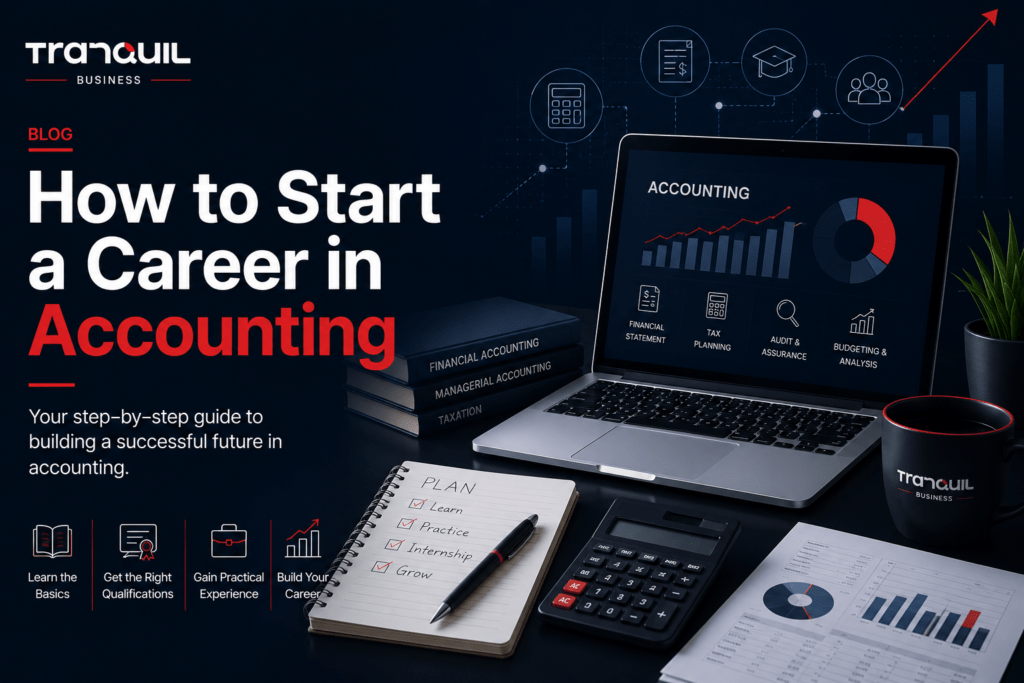
How to Start a Career in Accounting Accounting is one of the most stable, in-demand, and globally transferable careers in the world. Whether you’re a school leaver weighing your options, a graduate deciding on a specialisation, or someone mid-career looking for a change, accounting offers a clear path, strong earning potential, and the satisfaction of being the person businesses genuinely cannot do without. But knowing where to start can feel overwhelming. Which qualifications do you need? What skills matter most? And how do you land your first role in a competitive field?This guide answers all of it, step by step. What Does an Accountant Actually Do? Before committing to any career path, it’s worth understanding what the day-to-day really looks like. Accountants are responsible for recording, analysing, and reporting on financial information. But the role goes well beyond crunching numbers. Depending on the specialisation, an accountant might prepare tax returns and ensure regulatory compliance, manage payroll and employee benefits, produce monthly financial reports for management, advise businesses on cash flow and cost reduction, support audits and financial investigations, or help businesses plan for growth through budgeting and forecasting. The common thread? Accountants help people and organisations understand their financial position and make better decisions because of it. Step 1: Understand the Different Accounting Career Paths Accounting is not a single career, it’s a broad field with many distinct specialisations. Knowing which direction interests you will help you choose the right qualifications and entry points. Public Accounting:involves working for an accounting firm that serves multiple clients preparing taxes, auditing financial statements, and providing advisory services. This is often where new graduates start, as it offers rapid exposure to a wide variety of industries and clients. Management Accounting: means working within a business, helping leadership understand financial performance, manage budgets, and plan strategy. Management accountants are often called business partners because they sit at the intersection of finance and decision-making. Tax Accounting: focuses specifically on tax planning, preparation, and compliance — for individuals, businesses, or both. Tax accountants need strong knowledge of local and international tax law. Auditing:involves independently reviewing financial records to verify their accuracy and compliance. Internal auditors work within organisations; external auditors are hired from outside. Forensic Accounting: combines accounting expertise with investigative skills, often used in fraud detection, litigation support, and financial crime investigations. Bookkeeping and Accounts Management:Is the operational side of accounting managing day-to-day transactions, reconciling accounts, and maintaining accurate ledgers. This is often the entry point for those new to the field. Step 2: Get the Right Qualifications Formal qualifications remain the foundation of an accounting career. The specific path depends on your location, but the principle is universal: credentials matter. For School Leavers and Undergraduates A degree in accounting, finance, or a related business discipline is the most common starting point. Many universities offer bachelor’s programmes specifically in accounting, which cover financial reporting, taxation, auditing, and business law. Some students choose broader business degrees and specialise in accounting through electives or postgraduate study. Professional Accounting Certifications Across the globe, professional bodies certify accountants and their qualifications are recognised by employers everywhere. Key certifications include: CA (Chartered Accountant): offered by ICAI (India), ICAEW (UK), CAANZ (Australia/New Zealand), and ICAO (Canada). Highly respected and rigorous. CPA (Certified Public Accountant): the gold standard in the United States, and recognised globally. ACCA (Association of Chartered Certified Accountants): a globally recognised qualification particularly valued in the UK, Middle East, Asia, and Africa. CMA (Certified Management Accountant): focused on management and corporate accounting, ideal for those targeting in-house finance roles. AAT (Association of Accounting Technicians): a great entry-level qualification for those starting without a degree. Most of these certifications combine exams with a required period of practical experience typically two to three years, before you’re fully qualified. Do You Need a Degree to Become an Accountant? Not necessarily. Many successful accountants entered the profession through AAT or similar technician-level qualifications, then progressed to full certification through work experience. However, a relevant degree will typically accelerate your progression and open doors to more competitive graduate programmes. Step 3: Build the Core Skills Accounting Employers Look For Qualifications get you in the door, skills keep you in the room. Beyond technical knowledge, accounting employers consistently look for a specific set of competencies. Attention to Detail is non-negotiable. A single misplaced decimal point can have significant financial and legal consequences. Precision is the baseline expectation for every accounting role. Analytical Thinking goes hand-in-hand with detail. Accountants must not only record data accurately but interpret it — spotting trends, identifying anomalies, and drawing meaningful conclusions from financial information. Technology Proficiency is increasingly essential. Modern accounting relies heavily on software, Xero, QuickBooks, MYOB, SAP, and Excel remain industry staples. Familiarity with cloud accounting platforms, data visualisation tools, and increasingly AI-assisted bookkeeping tools will set you apart. Communication Skills might surprise some people on this list, but accountants must regularly translate complex financial information for non-financial stakeholders management, clients, investors, and regulators. Being able to explain numbers clearly is a highly valued skill. Ethical Judgement underpins everything in accounting. You will regularly handle sensitive financial information and face situations requiring professional integrity. Employers and professional bodies place significant weight on ethical conduct. Time Management and Organisation matter because accounting is often deadline-driven, tax filing dates, month-end closes, audit schedules, payroll cycles. The ability to manage multiple deadlines without compromising accuracy is essential. Step 4: Gain Practical Experience No qualification substitutes for real-world experience. In fact, most professional certifications require a defined period of supervised practical work as a condition of membership. Internships and Placements are the most direct route for students. Many universities have partnerships with accounting firms, and the Big Four (Deloitte, PwC, EY, KPMG) run well-regarded internship programmes globally. Even smaller local firms offer excellent hands-on experience. Entry-Level Roles such as accounts assistant, junior bookkeeper, or payroll assistant are ideal starting points. These roles build foundational skills, data entry, bank reconciliations, invoice processing that underpin every accounting career. Offshore and Remote Accounting Work has grown significantly as a career pathway, particularly for accountants in India, the Philippines, and Eastern Europe supporting businesses in the UK, USA, Canada, and Australia. This is an excellent route to gain international experience, work with diverse clients, and build your portfolio without relocating. Volunteering is an often-overlooked option. Offering basic bookkeeping support to a small charity